














Ironclad Island: Taiwan Unveils Historic $40 Billion Defense Budget to Build 'T-Dome' Shield
Taiwan's President Lai Ching-te announces a record $40 billion special defense budget to build a 'T-Dome' shield and counter China's rising military aggression.
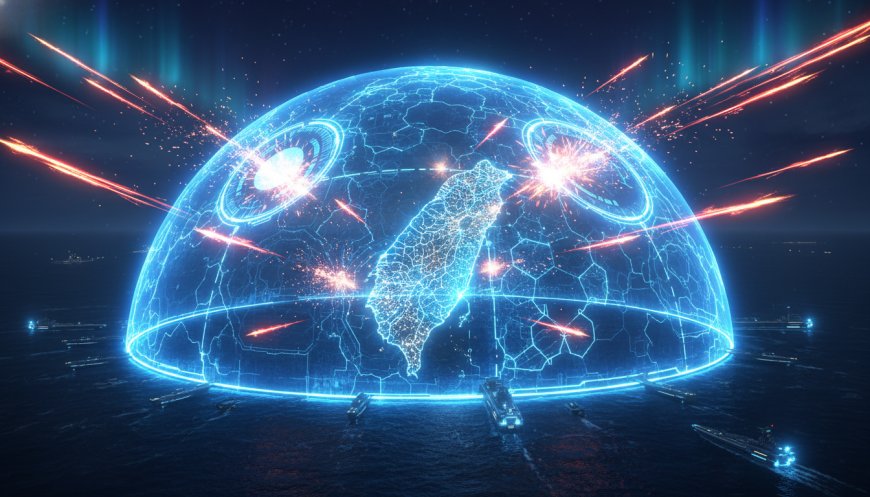
In a decisive move to fortify its sovereignty against an increasingly aggressive Beijing, Taiwan’s President Lai Ching-te has announced a historic special defense budget of approximately $40 billion (NT$1.25 trillion). Unveiled on Wednesday, this massive financial injection is designed to overhaul the self-governing island's military capabilities over the next eight years, from 2026 to 2033. At the heart of this strategy is the ambitious development of a "T-Dome"—a multi-layered air defense network intended to turn the island into an unassailable fortress.
**A "Historic" Pivot for National Survival**
President Lai, speaking from the Presidential Office in Taipei, framed the budget not merely as a policy adjustment but as a necessity for national survival. "Among all the possible scenarios for China's annexation of Taiwan, the biggest threat is not force—it is our own surrender," Lai stated, emphasizing that "peace through strength" is the only viable path forward. The proposal marks a significant escalation in Taipei's determination to deter a potential invasion by the People's Liberation Army (PLA), which has been staging daily military incursions into Taiwan's air defense identification zone (ADIZ).
The new budget is separate from the annual general defense spending, which is already set to reach a record NT$949.5 billion ($30.3 billion) in 2026, or about 3.3% of the island's Gross Domestic Product (GDP). With the supplementary funds, Lai aims to push Taiwan's total defense expenditure closer to the 5% of GDP mark by 2030, a target that signals Taipei's seriousness to both its adversaries and its allies.
**The "T-Dome": Shielding the Island Democracy**
The centerpiece of this new spending plan is the "T-Dome," a concept drawing clear conceptual parallels to Israel's Iron Dome. Defense Minister Wellington Koo detailed that this system aims to provide comprehensive, multi-tiered protection against Chinese missiles, drones, and aircraft. The T-Dome will integrate advanced radar systems, AI-driven command centers, and a diverse array of interceptors to protect critical infrastructure, military bases, and civilian population centers from saturation attacks.
"The ultimate goal is to establish defense capabilities that can permanently safeguard democratic Taiwan," Lai explained. This shift towards asymmetric warfare—prioritizing mobile, lethal, and hard-to-target systems like drones and anti-ship missiles—reflects the "porcupine strategy" long advocated by U.S. military strategists. The budget will also fund the acquisition of long-range precision-strike missiles capable of hitting targets deep within the Chinese mainland, a capability intended to raise the cost of any military adventure Beijing might consider.
**The Shadow of US Politics and Geopolitics**
The timing of the announcement is inextricably linked to the shifting geopolitical landscape, particularly the imminent return of Donald Trump to the White House. The President-elect has frequently employed transactional rhetoric regarding US alliances, previously suggesting that Taiwan should pay "protection money" and raising the bar for defense spending to as much as 10% of GDP. By proactively announcing this massive spending package, the Lai administration appears to be front-running potential pressure from Washington, demonstrating that Taiwan is willing to shoulder the financial burden of its own defense.
"This is a clear signal to the incoming US administration that Taiwan is not a free-rider," said a Taipei-based security analyst. "It aligns perfectly with the 'America First' demand for allies to pay their fair share." The move follows the US State Department's recent approval of a $330 million sale of spare parts for Taiwan's F-16 fleet and radar systems, further underscoring the deep, albeit unofficial, military partnership between the two democracies.
**Domestic Hurdles and Beijing's Fury**
While the strategic logic is clear, the political path ahead is fraught with challenges. President Lai's Democratic Progressive Party (DPP) does not hold a majority in the Legislative Yuan. The budget must pass through a parliament controlled by the opposition Kuomintang (KMT) and the Taiwan People's Party (TPP), both of which favor a more conciliatory approach toward Beijing. The KMT has previously blocked or stalled defense budgets, arguing that they provoke China and drain resources from social welfare. However, with public anxiety over China's gray-zone warfare growing, rejecting a budget explicitly framed as "national survival" could prove politically costly for the opposition.
Predictably, the reaction from Beijing was swift and hostile. The Taiwan Affairs Office (TAO) condemned the budget as "squandering the hard-earned money of the Taiwan people to buy weapons from foreign masters." A spokesperson for the Chinese Foreign Ministry warned that "attempts to resist reunification with force are doomed to fail," reiterating the Communist Party's stance that Taiwan is a rogue province to be "reunified," by force if necessary.
**A Race Against Time**
Security experts often point to 2027—the centennial of the PLA—as a potential window for a Chinese offensive, a timeline cited by former US Indo-Pacific commanders. By locking in funding through 2033, Taiwan is attempting to close the window of vulnerability. The investment in domestic arms production, alongside purchases of American hardware like Harpoon missiles and HIMARS systems, is a race to make the island "unswallowable" before the PLA's modernization reaches its peak.
As tensions in the Taiwan Strait reach a boiling point, this $40 billion gamble represents one of the most significant shifts in the region's security architecture in decades. For Lai Ching-te and the people of Taiwan, the message is stark: the price of freedom is rising, and they are preparing to pay it.
What's Your Reaction?








Anderson Cooper
Anderson Cooper – Veteran Journalist Located in Africa
Anderson Cooper is a distinguished 61-year-old journalist who has dedicated his life to the pursuit of truth and impactful storytelling. Though globally known for his work in television journalism, his current focus is rooted in Africa, where he continues to report on critical issues shaping the continent and the world.
With decades of experience, Cooper has built a reputation for courage, integrity, and insightful reporting. His journalism has spanned politics, international conflicts, humanitarian crises, and stories of social change. By being based in Africa, he has brought global attention to underreported narratives, highlighting the challenges and resilience of communities across the region.
Known for his empathetic approach and fearless reporting, Anderson Cooper embodies the principles of journalism that prioritize truth, awareness, and public service. At 61, his career continues to inspire aspiring journalists worldwide, proving that passion for storytelling knows no boundaries.