












Bolsonaro Behind Bars: Ex-Brazil President Begins 27-Year Prison Sentence for Coup Plot
Former Brazilian President Jair Bolsonaro has officially begun serving a 27-year prison sentence for plotting a coup to overthrow the government in 2022.
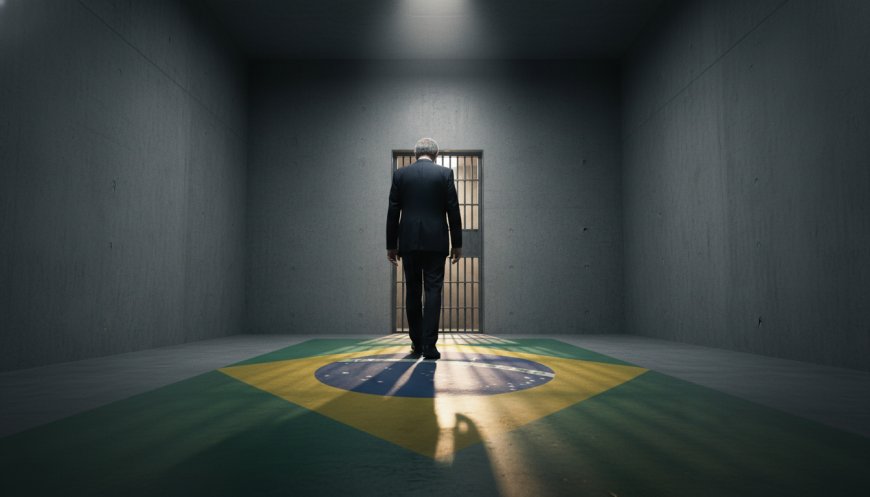
BRASILIA — In a historic and polarizing moment for Latin America’s largest democracy, former Brazilian President Jair Bolsonaro has officially begun serving a 27-year prison sentence. The development, confirmed late Tuesday by Brazil’s Supreme Court, marks the final chapter in the legal saga surrounding the far-right leader’s attempts to overturn the results of the 2022 election.
Supreme Court Justice Alexandre de Moraes ordered the immediate commencement of the sentence after ruling that Bolsonaro’s defense had exhausted all possible avenues of appeal. The 70-year-old populist, who once commanded millions of fervent supporters, is now incarcerated in a specially prepared cell at the Federal Police headquarters in Brasilia.
**From Palace to Prison: The Final Ruling**
The transition from political heavyweight to convicted felon accelerated rapidly over the last 96 hours. While Bolsonaro was already in preventive custody as of Saturday—following an incident where he allegedly tampered with his electronic ankle monitor using a soldering iron—Tuesday’s ruling transformed his detention into a formal prison term.
Justice de Moraes was unequivocal in his decision, stating that the "guilty verdict has become final." The court rejected the defense's last-ditch request for house arrest based on Bolsonaro's alleged poor health. Instead, the former captain will serve his time in a 12-square-meter room equipped with a bed, a private bathroom, and a desk, isolated from other inmates to ensure his safety and prevent political rallying from within the walls.
**The Charges: A "Violent Abolition of Democracy"**
Bolsonaro’s 27-year sentence stems from a conviction handed down in September, which found him guilty of a complex and harrowing conspiracy to keep himself in power despite losing the election to Luiz Inácio Lula da Silva. The charges paint a picture of a desperate administration willing to go to extreme lengths to subvert the will of the people.
According to the Federal Police and the Supreme Court’s findings, the coup plot was not merely theoretical. It included:
* **Assassination Plans:** Detailed discussions on the potential poisoning or assassination of then-President-elect Lula da Silva, his Vice President Geraldo Alckmin, and Justice Alexandre de Moraes himself.
* **Military Interference:** Active pressure on high-ranking military officers to intervene and prevent the transfer of power.
* **Criminal Organization:** Leading an armed criminal group dedicated to the "violent abolition of the democratic rule of law."
"The evidence gathered confirms that the former president was the central architect of a plan that would have plunged Brazil into a dictatorship," the Prosecutor General’s office stated during the final proceedings.
**The Ankle Monitor Incident**
The drama leading up to his incarceration took a bizarre turn over the weekend. Bolsonaro had been under house arrest since August 2025. However, on Saturday, authorities were alerted that his electronic tracking device had been damaged. Upon his preventive arrest, Bolsonaro claimed he was suffering from "hallucinations" and "paranoia," believing the device contained a wiretap, which led him to try and remove it. Justice de Moraes dismissed these claims, citing them as a willful attempt to evade justice and potentially flee the country.
**A Nation Divided**
News of the sentence has sent shockwaves through Brazil, reigniting the deep political fissures that have defined the nation for the last decade. Outside the Federal Police headquarters, the scene was a microcosm of the country's divide. Small groups of die-hard supporters, draped in the national colors of yellow and green, held vigils and wept, decrying the sentence as a "political witch hunt." Conversely, detractors celebrated in the streets of Rio de Janeiro and São Paulo, viewing the imprisonment as a victory for the rule of law and a safeguard against authoritarianism.
"This proves that no one is above the law, not even a former president," said Maria Silva, a pro-democracy activist in Brasilia. "We came to the brink of losing our democracy, and today justice has been served."
**International Fallout and Trump's Tariff Threat**
The reverberations of Bolsonaro’s imprisonment are being felt far beyond Brazil’s borders. In the United States, President-elect Donald Trump, a close ideological ally of Bolsonaro, has reacted aggressively to the legal proceedings. Trump has characterized the trial as unfair and threatened to impose a 50% tariff on all Brazilian goods, a move that could devastate trade relations between the two Western Hemisphere giants.
"The treatment of my friend Jair is a disgrace," Trump posted on social media, signaling that diplomatic tensions between Washington and Brasilia may escalate significantly in the coming months.
**What Lies Ahead?**
For Bolsonaro, the road effectively ends here. Under Brazilian law, he will not be eligible for parole for several years, and his political eligibility had already been stripped until 2030—a ban that will now likely extend well into the 2040s. His imprisonment leaves a power vacuum in Brazil’s conservative movement, with potential heirs already scrambling to inherit his political capital.
Meanwhile, the Federal Police continue to round up other key figures in the coup plot. Former Justice Minister Anderson Torres and several high-ranking generals have also received lengthy sentences, dismantling the network that once underpinned the Bolsonaro administration. As the heavy steel doors close in Brasilia, Brazil turns a page, hoping to heal the wounds of a tumultuous era, even as the echoes of the coup attempt continue to resonate.
What's Your Reaction?








Anderson Cooper
Anderson Cooper – Veteran Journalist Located in Africa
Anderson Cooper is a distinguished 61-year-old journalist who has dedicated his life to the pursuit of truth and impactful storytelling. Though globally known for his work in television journalism, his current focus is rooted in Africa, where he continues to report on critical issues shaping the continent and the world.
With decades of experience, Cooper has built a reputation for courage, integrity, and insightful reporting. His journalism has spanned politics, international conflicts, humanitarian crises, and stories of social change. By being based in Africa, he has brought global attention to underreported narratives, highlighting the challenges and resilience of communities across the region.
Known for his empathetic approach and fearless reporting, Anderson Cooper embodies the principles of journalism that prioritize truth, awareness, and public service. At 61, his career continues to inspire aspiring journalists worldwide, proving that passion for storytelling knows no boundaries.